Fast, deep, right: what a week of shocks says about trusting a market move
Nvidia's CEO resigned, the race to succeed him opened on almost no money, and the December Fed went from a coin flip to a near-certain hike. One question runs through all three: when a prediction market moves, how do you know the move is real?
Three shocks, one question
Every prediction-market price is a claim about the future. Most weeks, the interesting question is whether the claim is right. This week the better question came earlier: when a market moves, is the move information, or is it noise that will be gone in an hour?
Three very different stories gave us a clean test. A deep, heavily traded market on whether Nvidia's chief executive would leave. A brand-new, thin market on who would replace him. And the most important macro market there is, the next Federal Reserve decision, on a week with a hot inflation print. We follow each in turn, then tie them together with our own recorded data.
All times are UTC, which is UK time in November; New York is five hours behind. Prices are mid prices from Polymarket and Kalshi unless we say otherwise.
Nvidia, part one: a deep market that moved early and held
On Sunday 8 November Nvidia's board opened a formal review following press reports concerning Jensen Huang. Polymarket's market on whether Huang's departure as CEO would be announced by 31 December traded between 10% and 17% that night and on Monday. On Kalshi, the matching market sat between 11% and 21% from Monday to Wednesday afternoon.
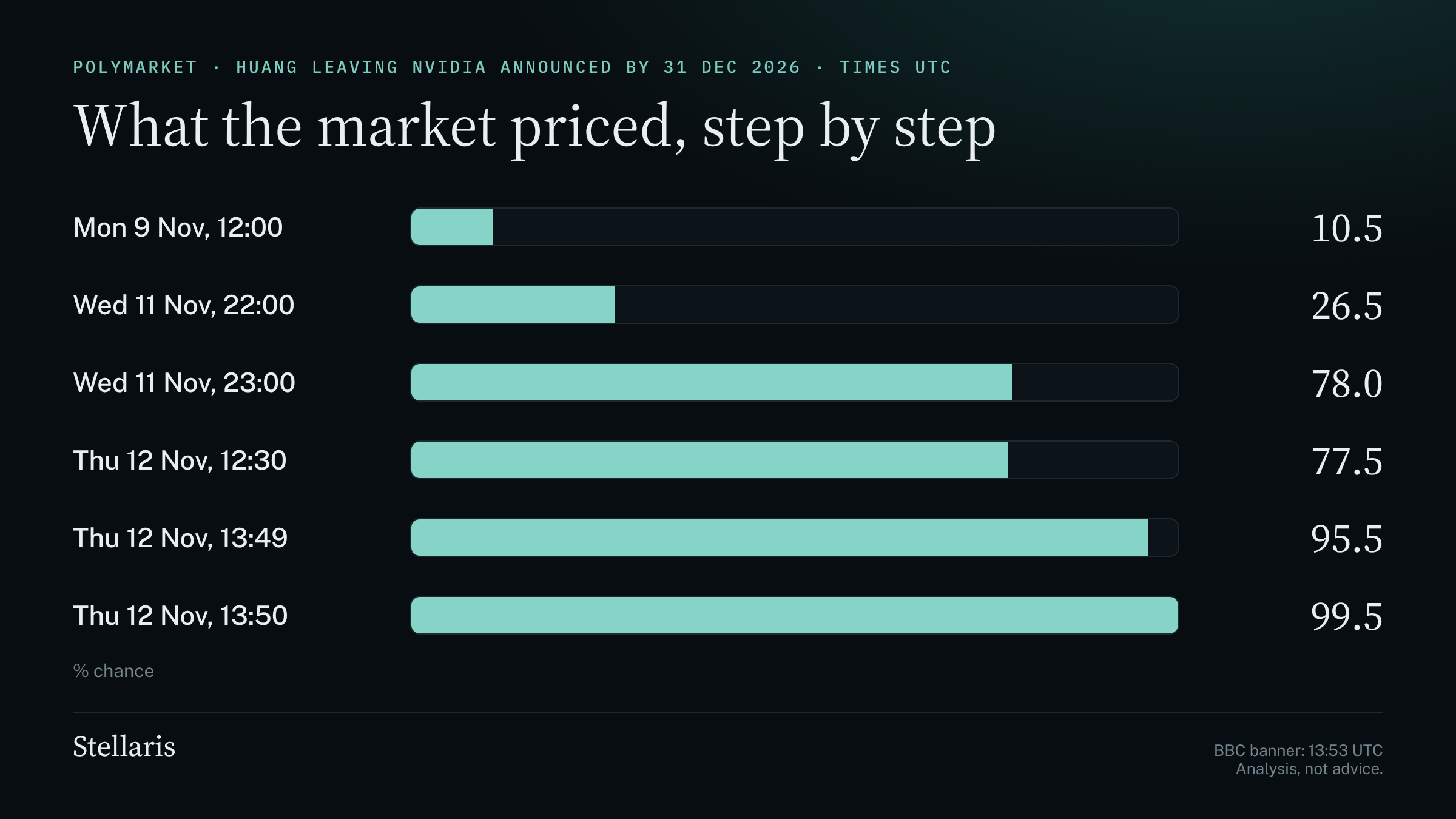
Then, between 22:00 and 23:00 on Wednesday 11 November, both venues jumped together: Polymarket from 26% to 78%, Kalshi from 29% to 77%. More than 1.1 million Kalshi contracts changed hands in that hour. We do not know what triggered it, and price data cannot tell us. What it can tell us is that this was not a thin market being pushed around: Polymarket's markets on the question have more than $20 million traded in total, and two separate venues made the same move in the same hour.
Fourteen hours at 75 to 80%
What happened next is the part worth remembering. The price did not run on to 95%. From midnight to early afternoon on Thursday it held between 75% and 80% on both venues. In plain words, the market said: this will probably happen, and there is still a one-in-four chance it does not.
That is what a well-calibrated market is supposed to do with incomplete news. A probability of 78% is not a forecast that something will happen; it is a statement that it happens about four times in five. At 12:30 on Thursday, Polymarket priced about 40% that the announcement would come before the end of Thursday, New York time, and about 52% by the end of Friday. The market was not only saying "likely" but roughly "soon".
Three minutes
At 13:49 Polymarket moved to 95.5%, and at 13:50 to 99.5%. Kalshi went from 77% to 90% and then 99% in the same two minutes. The BBC's live page carried the breaking banner, "Jensen Huang steps down as Nvidia CEO, company's board says", at 13:53.
It would be easy to read this as the market knowing first. We would not. Company statements reach newswires, terminals and social media before a live page updates, and traders who watch those feeds price them in seconds. What the timing does show is how quickly a deep market absorbs public news: within a minute or two of it existing, the price said 99%.
Nvidia, part two: a thin market that kept changing its mind
The market on who would replace Huang tells the opposite story. Polymarket opened it on Tuesday 10 November. For the first day it barely traded, and its prices meant almost nothing: two candidates sat at about 45% each at the same time, which is what an empty book looks like, not a view.
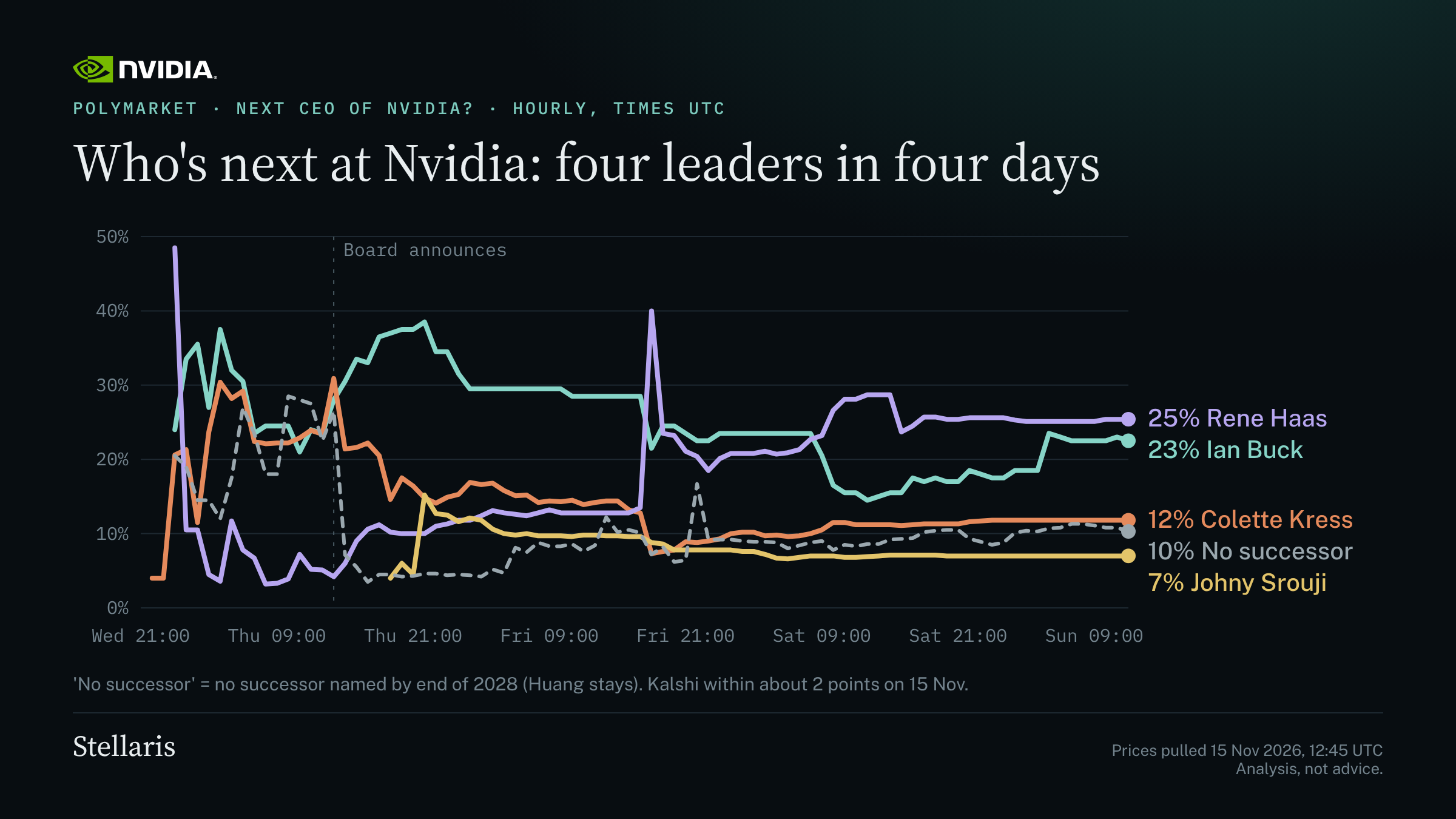
When real money arrived on Wednesday night, the first prices were wild. Rene Haas, the chief executive of Arm, traded at about 48% around 23:30. Colette Kress, Nvidia's chief financial officer, had touched a similar level an hour earlier. Both fell back within the hour. At that point Haas's market had about $14,000 traded in total. A price of 48% on that much money is a handful of orders, not a consensus.
Through Thursday morning the favourite was not a person at all. "No successor", which pays out if nobody is named by the end of 2028, in practice a position that Huang stays, led at about 28%. It fell to about 5% within minutes of the board's statement. Ian Buck, the Nvidia vice-president who created its CUDA software platform, then took the lead, peaking near 38% on Thursday evening and settling at 29% by Friday.
Then the story turned. On Friday evening Haas spiked again, to about 40%, and fell back to the mid-20s. On Saturday morning he took the lead and kept it. At midday on Sunday Polymarket had Haas at 25%, Buck 23%, Kress 12%, "no successor" 10% and Johny Srouji of Apple 7%; Kalshi had Haas at 25 to 27%, Buck 22 to 23% and Kress 10 to 11%. Haas's Polymarket market now has about $150,000 traded, ten times Wednesday's. We do not know what moved it, and price data cannot tell us.
The December Fed: deep, agreed, and held
The third story moved more slowly and matters more to most of our readers. In early September, Polymarket's market on the December Fed decision was a coin flip: a hike of any size at 49%, no change at 45%. Through October it settled at about 75 to 80% for a hike.
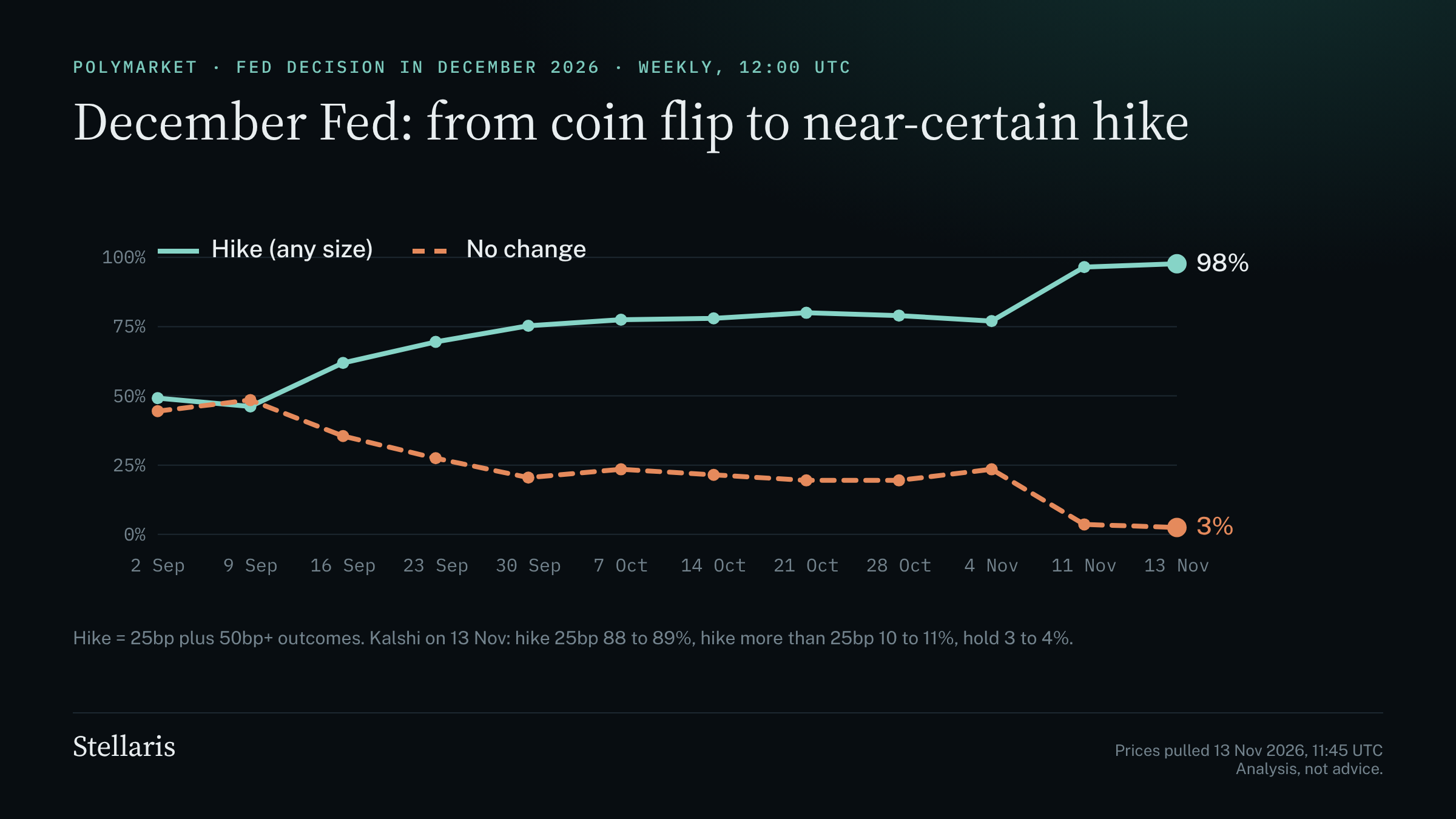
Then came this week. On Monday afternoon "no change" stood at about 20% and a 50bp-or-larger hike at 0.5%. By 14:00 on Tuesday, the day October's CPI printed +0.4% for the month, "no change" was 2.6% and a big hike 11.8%. Part of the move came before the 13:30 release, and we do not know why. It then barely moved for the rest of the week: at 12:00 UTC on Sunday, Polymarket had 25bp at 86%, 50bp or more at 9% and no change at 4%.
Our recordings show what the books did around the print. Across 48 US markets tied to the release, the money resting near the price fell to 74% of its earlier level five minutes before 13:30 and had not recovered by 15:00. The quotes thinned out just before the number, the moment the price mattered most. Deep markets like the December Fed absorb that; thin ones do not.
The reason we take this price seriously is not that it is high. It is that the books are deep and two venues agree. Polymarket's December market has about $34 million traded. On Kalshi, more than 1.9 million contracts are open on a 25bp hike and 2.3 million on a larger one, and its prices match Polymarket's within one or two points: 87% for 25bp, 10% for more, 4% for no change. Our integrity score, which combines the spread, the depth near the price, how recently it traded and how concentrated the trading is, rates every December decision line between 94 and 100 out of 100 on both venues.
What ties them together: 535 big moves
These are three stories. To test the pattern properly we went to our own data: order books we record every minute on both venues, for about 1,300 non-sports markets.
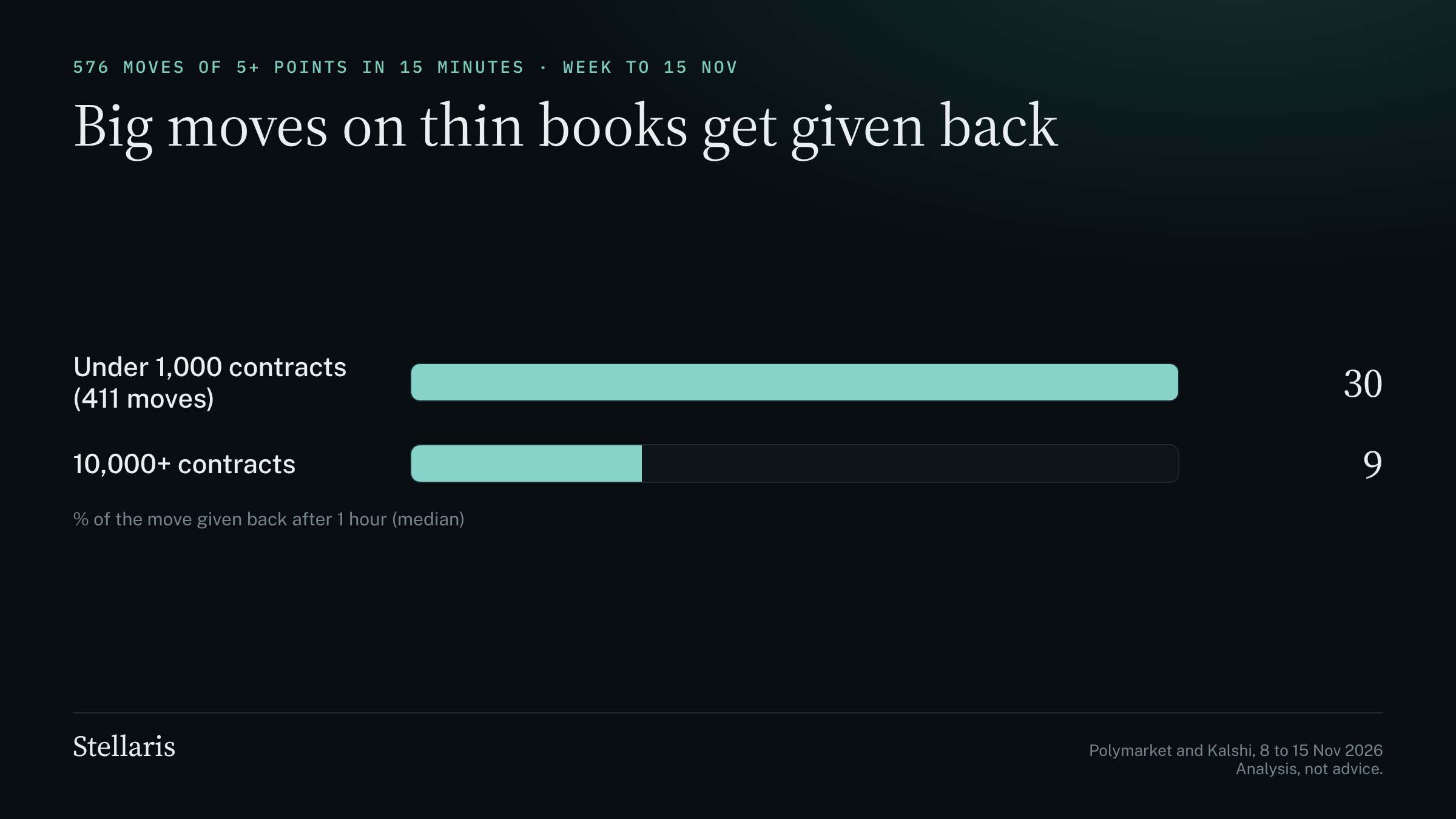
In the week to Sunday we found 576 moves of 5 points or more within 15 minutes. 411 of them, 71%, happened with fewer than 1,000 contracts resting near the price. An hour later, those thin-book moves had given back a median 30% of the move. Moves with 10,000 or more contracts behind them gave back 9%.
Two honest caveats. First, a 30% give-back means the typical thin move kept about 70% of its size: thin moves are noisy, not wrong. Rene Haas is the week's example. Second, some of what is given back is mechanical. We measure the middle of the book, not the last trade, which removes most of the bounce between buying and selling prices, but in a thin book a single small order placed or pulled moves the middle on its own. And some reversals are simply new news. Deep markets get new news too, which is why the comparison between the two is the useful number.
Thin books are also common. On Thursday morning a third of the 1,325 markets we track had fewer than 1,000 contracts near the price. For macro markets the share was 37%; for energy 25%; for the midterm markets still open, 50%.
What we expect to see next
Expectations here are about the markets and the data, not advice on what to do. Probabilities are the markets', labelled as such.
- Tue 17 Nov, after the US close (from about 21:00 UK, 16:00 ET): Nvidia's third-quarter results (date from the venues' market listings; confirm on Nvidia's investor site), its first since Huang's exit. Kalshi prices a postponed call at 1 to 3%, with about 210,000 contracts open. Polymarket's "beat expectations" market has under $4,000 traded, so we would not read much into its price. We expect the next-CEO prices to move on anything the company says about succession, and we will check whether those moves hold for an hour.
- Tue 17 Nov, 13:30 UK (08:30 ET): US retail sales for October. We found no prediction market on it.
- Fri 4 Dec, 13:30 UK (08:30 ET): November jobs. The two venues disagree: Kalshi's payrolls ladder puts the median near 90,000, Polymarket's bands near 105,000. Both are thin (a few hundred to 3,000 contracts per Kalshi strike; our integrity score rates Polymarket's bands 50 to 63, against 94 to 100 for the Fed), and we would expect both to be jumpy into the release. Unemployment above 4.1%: 42 to 44% on Kalshi.
- Wed 9 Dec, 19:00 UK (14:00 ET): the Fed decision, priced at about 98% for a hike. January is less settled: Kalshi has a further hike at 58 to 59% and a hold at 39 to 40%.
- Thu 10 Dec, 13:30 UK (08:30 ET): November CPI, the day after the Fed decides. This is the interesting one.
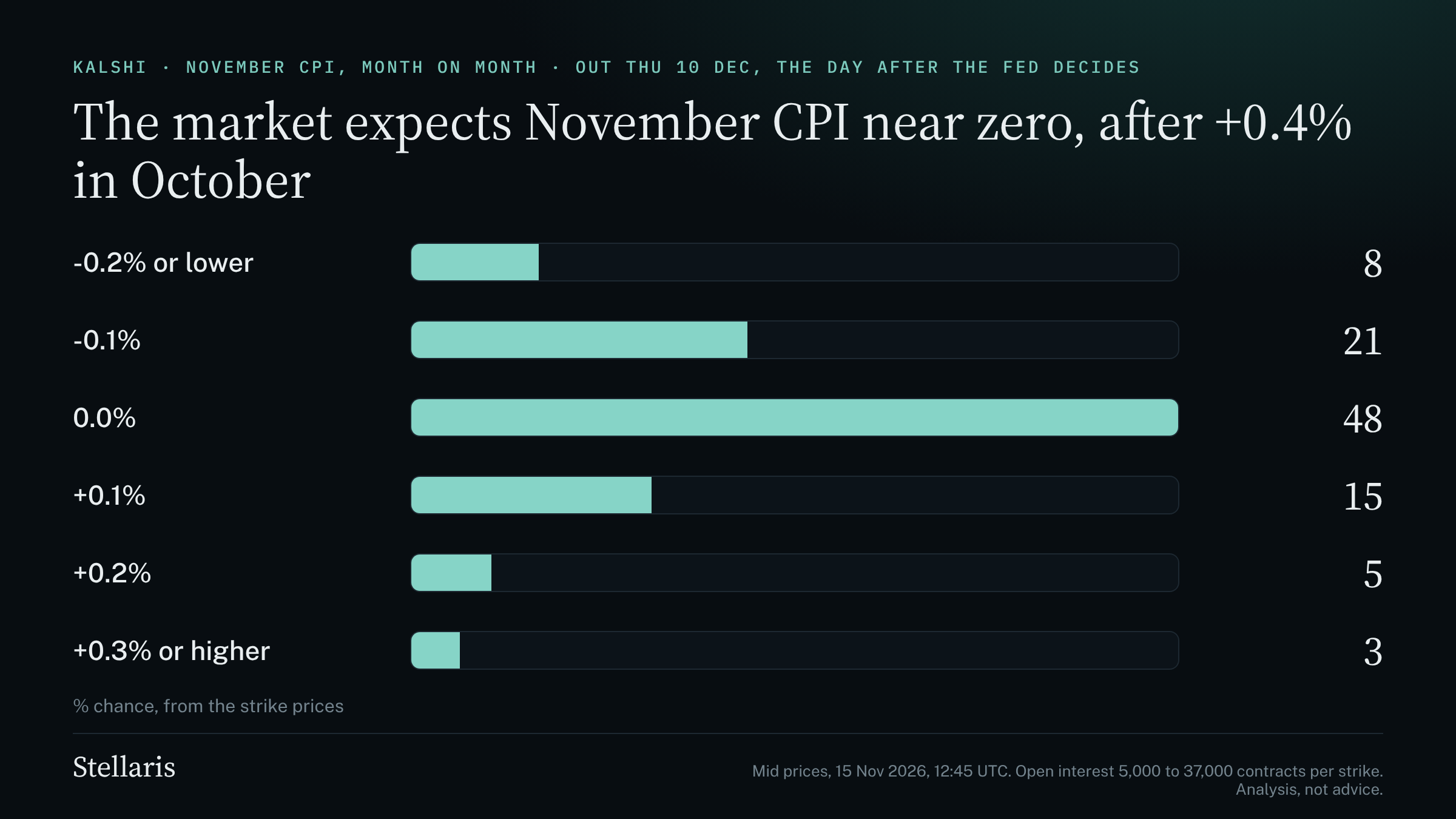
Kalshi's ladder for November's monthly CPI puts about 77% on 0.0% or lower, with 0.0% the single most likely print at about 48%, after October's +0.4%. Polymarket says the same: 0.0% at 42%, -0.1% at 28%, about 77% at 0.0% or below. A day earlier Kalshi had only about two-thirds there, so the market has been moving towards a soft print. Core is priced higher: Polymarket's thin core market (under $3,000 traded) has 0.2% at 42% and 0.3% at 35%. So the markets expect the Fed to raise rates on a Wednesday, and expect a soft headline inflation number on the Thursday. That is not a contradiction: the Fed looks at core inflation, trends and its own forecasts, not one month. But it is the gap we will watch, and the CPI markets are deep enough on Kalshi (5,000 to 37,000 contracts open per strike) to take seriously.
Our scorecard
- Jobs, Fri 6 Nov: both ranges we published before the release held (payrolls +165,000, inside the open top band; unemployment 4.1%, inside 4.06% to 4.31%). Running tally: 2 of 2. Too few to mean much yet.
- CPI, Tue 10 Nov: we did not publish a range before this release, so it does not count in the tally. The market's favourite for the monthly figure was 0.2% at 55%, backed by 79 contracts; the print was 0.4%, which the market had at about 8%. We had planned a preview and missed it; we said so in our post that afternoon.
- Huang: the market said 10 to 20% on Monday, and it happened on Thursday. One event cannot score a forecast: a 15% event happens about one time in seven. This goes into the record, not the tally.
The five trust levels
Each market gets a score from 0 to 100 for how much weight its price deserves, from spread, depth, staleness, trader concentration, wash-trading patterns and turnover. How the score works · Guide: what a trust score is, and what it can't tell you.
What to keep in mind
- Prices are mid prices from the venues' public data, captured from 13 to 15 November at the times shown. The 576-move study (8 to 15 November, 10:00 UTC), the thin-book census (12 November) and the integrity scores (15 November, 12:00 UTC) use our own minute-by-minute order-book recordings.
- Depth is contracts resting within 5 cents of the price. Kalshi's "open interest" is the number of contracts outstanding, a different measure.
- Polymarket's and Kalshi's markets on the same question can have different rules. We say where they differ; read the rules before comparing prices.
- Implied distributions from strike ladders are our calculation; open-ended tails are shown as "or lower" and "or higher".
- Analysis of public market data, not investment advice. Stellaris is a trading name of Lumen Labs Limited.
This is analysis of public market data, not investment advice or a recommendation to trade. Stellaris is not a trading venue, broker or adviser and does not trade. Prices are those shown by the venues at the times stated and can change. Trust levels come from our published method and have known limits.